Dollar Bank Heritage Center
By Dollar Savings Bank, CC BY-SA 3.0 us
Website:
https://dollar.bank/about/our-history
Telephone Number:
Location:
340 Fourth Ave, Pittsburgh, PA 15222
Hours:
Mondays through Fridays 9:00 AM to 5:00 PM
Description:
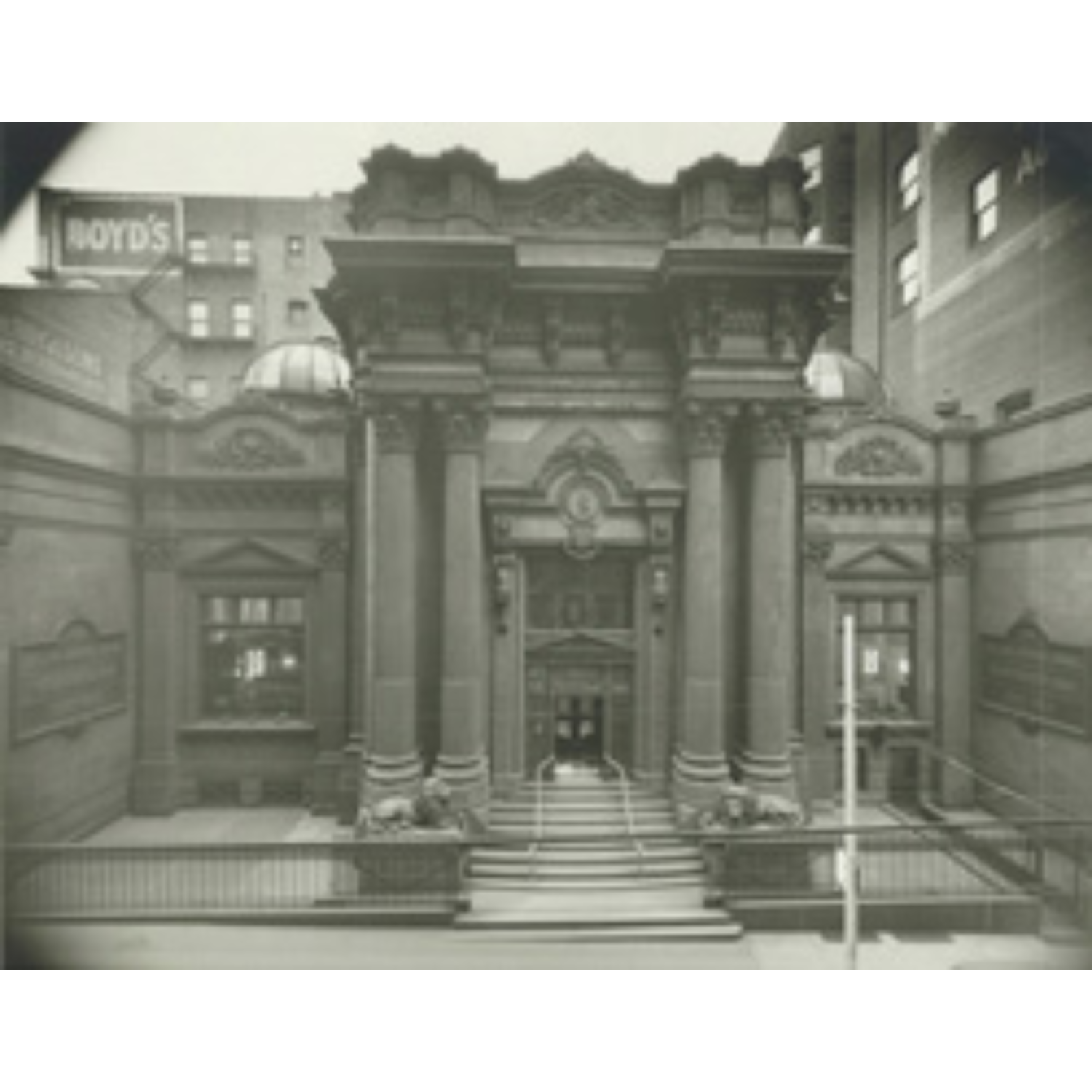
Dollar Bank’s Fourth Avenue Building in downtown Pittsburgh is one of the city’s oldest surviving bank structures and a celebrated example of mid‑19th‑century Beaux‑Arts civic architecture designed to convey permanence, confidence, and financial stability. Constructed between 1869 and 1871 to house the newly expanding Dollar Savings Bank — the city’s first mutual savings institution, notable for allowing savings accounts to be opened with as little as one dollar — the building was designed by Isaac H. Hobbs & Sons of Philadelphia and built using more than 14,000 tons of Connecticut brownstone complemented with granite, marble, and brass details throughout.
The grand façade is articulated with robust masonry, large columns, and classical motifs that set a high architectural standard for subsequent bank buildings along Fourth Avenue, Pittsburgh’s historic financial district. Flanking the main entrance are two monumental stone lions carved on site from single blocks of quarry‑bedded brownstone by sculptor Max Kohler and his assistant R. C. Morgan; these lions have become enduring symbols of the bank’s commitment to safeguarding its customers’ savings and are among the most recognizable sculptural figures in the city’s built environment. Over time the building was expanded — including executive offices and a board room in 1896 and wings in 1905 under Pittsburgh architect James T. Steen — yet it has remained continuously owned and operated by Dollar Bank and was placed on the National Register of Historic Places in 1976.
Today, the original lions are preserved inside the banking hall after restoration, with exact replicas guarding the entrance steps, and the building also houses the Dollar Bank Heritage Center, which celebrates the institution’s long history through displays of vintage banking equipment, historic ledgers, and archival materials.